Skip to content
The Things Stack documentation home
Getting Started Concepts Cloud Enterprise Integrations API Hardware
Getting Started Concepts
Cloud Enterprise
Integrations API Hardware
Get The Things Stack

    Recent searches

      Popular pages

      • Getting Started
      • Adding Gateways
      • Adding Devices
      • Payload Formatters
      • Webhooks
      • Authentication

      No results for “”.

      • Check the spelling, or try fewer or more general words.
      • Ask the community on The Things Network Forum
      • Contact support
      ↑↓ to navigate ↵ to open Esc to close

      Hardware

      • Overview
      • Devices
      • Gateways
        • Concepts
          • Adding Gateways
          • LoRa Basics™ Station
            • Configuration and Update Server (CUPS)
            • LoRaWAN Network Server (LNS)
            • Using CUPS to redirect to a different LNS
            • Implementation Guide
            • mTLS Authentication
          • Semtech UDP Packet Forwarder
          • The Things Industries Gateway Protocol
          • Packet Forwarders
          • Gateway Round Trip Times
        • Models
        • Troubleshooting Gateways
      • Works with The Things Stack

      Using CUPS to redirect to a different LNS

      Updated 20 January 2025 Edit on GitHub
      Copy page
      • View as MarkdownThis page as plain text
      • Open in ChatGPTAsk questions about this page
      • Open in ClaudeAsk questions about this page

      This section explains how redirect your gateway from one The Things Stack instance to another using CUPS, thus facilitating remote gateway management.

      If your gateway is using CUPS to connect to The Things Stack, and you want to redirect it from one The Things Stack instance to another, just follow the steps below. As an example, we consider redirecting a gateway from The Things Stack Sandbox to The Things Stack Cloud.

      First, register your gateway in the target instance (The Things Stack Cloud in our example). You can choose to Generate API key for LNS upon registering, or to follow steps to create an LNS key (gateway API key with linking rights) in the target instance after registering.
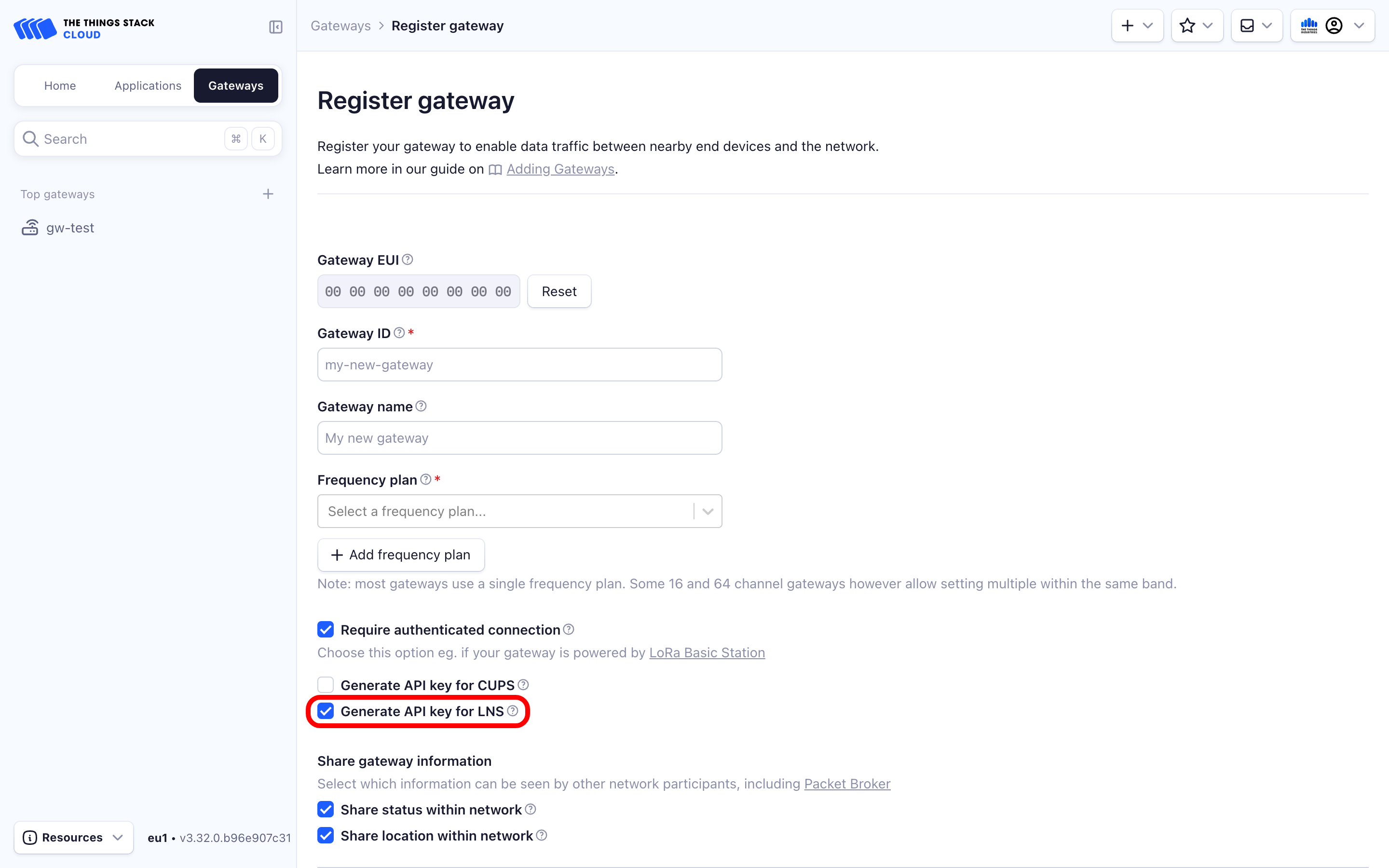
      Registering gateway in the target The Things Stack instance

      Copy the LNS key from the target instance (that you created in previous step). In the source instance (The Things Stack Sandbox in our example), navigate to your gateway’s General settings tab and paste the LNS key you’ve copied in the LoRa Basics Station LNS Authentication Key field.

      Navigate to your gateway’s General settings tab in the target instance, copy the Gateway Server address and paste it in the Gateway Server address field of the source instance.
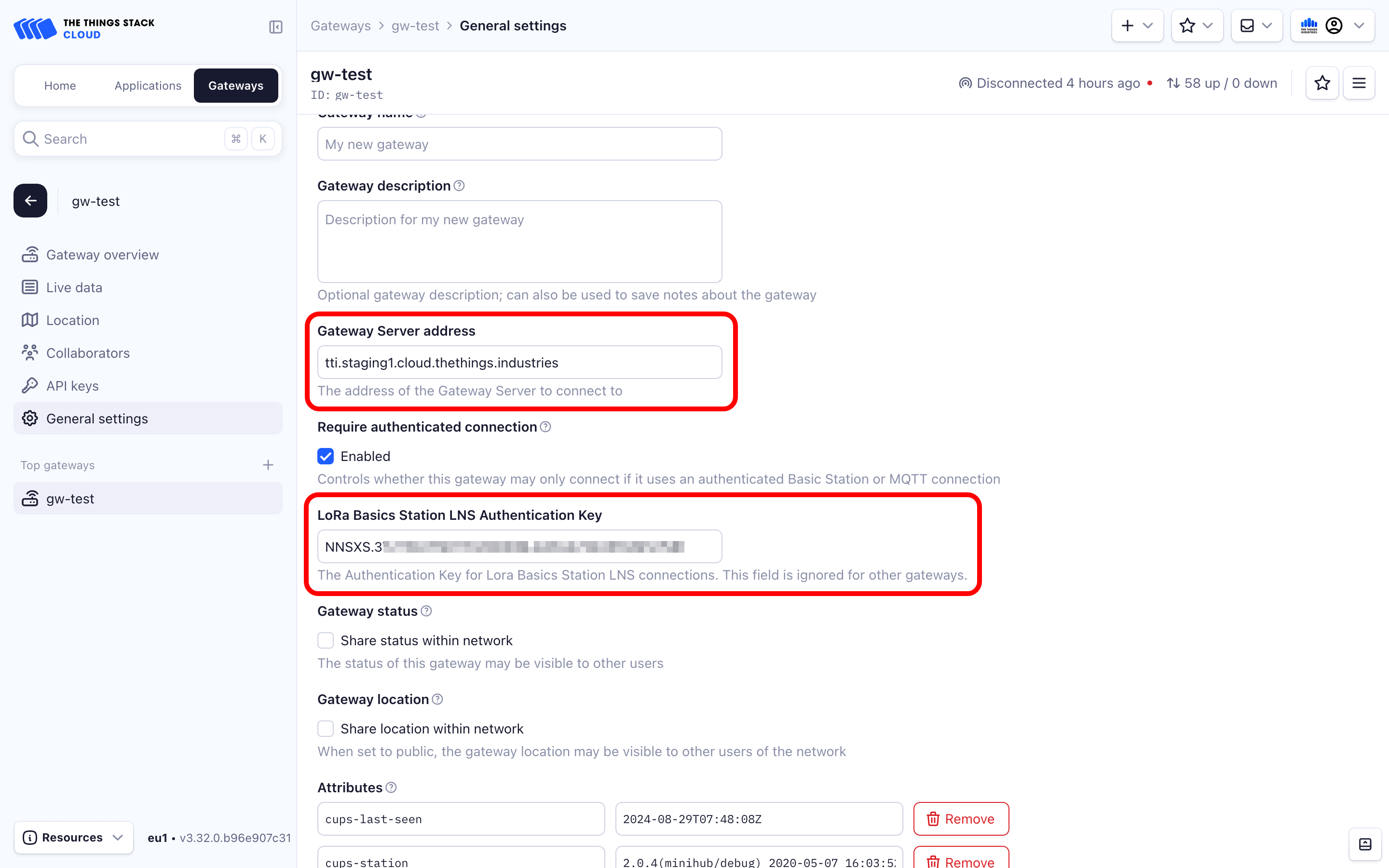
      Changing LNS key and GS address in the source instance

      You can optionally invalidate the old LNS key in the source instance, either by deleting it or by removing the linking right.

      Upon the next CUPS request, the gateway will connect to the target The Things Stack instance and stop sending packets to the source instance. Usually, a CUPS request is sent every 24h, but in this case, it will happen sooner. Changing the Gateway Server address forces the gateway to reconnect in about 10 minutes on average. Also, invalidating the old LNS key in the source instance results in CUPS lookup being done before the 24h window finishes, during which the gateway will redirect to the target instance.

      ← LoRaWAN Network Server (LNS) Implementation Guide →

      Sections

      Getting Started

      Concepts

      Cloud

      Enterprise

      Integrations

      API

      Hardware

      Sitemap

      View our Sitemap

      Contributing

      GitHub

      About Us

      The Things Industries

      Privacy Policy

      Cookie settings

      Cookie Settings

      We use cookies to enhance your experience, analyze site traffic and deliver personalized content. Read our Privacy Policy.

      Cookie categories